
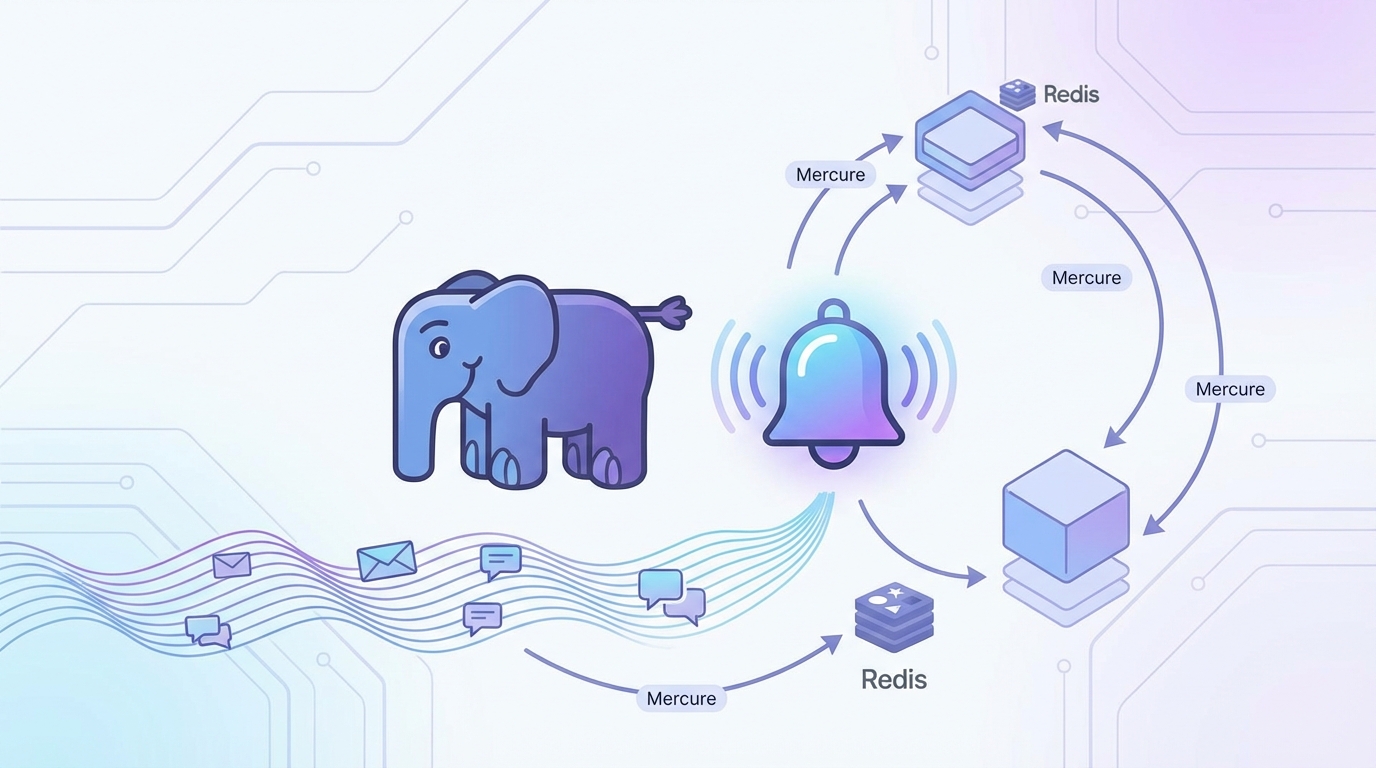
Real-time features are expected in modern apps, but many teams still run into the same pain points: dropped events, overloaded workers, and hard-to-debug socket failures in production. If you are building notifications, collaborative updates, or live dashboards, you need a design that handles bursts without losing reliability.
In this guide, we will build a practical Node.js event delivery architecture using uWebSockets.js for high-throughput WebSocket connections, NATS JetStream as a durable event backbone, and idempotent consumers for safe retries. We will keep the examples framework-friendly so you can adapt this to Express, Fastify, or NestJS.
Why this architecture works
Pure in-memory pub/sub is fast but fragile. Durable queues are reliable but can add latency if used alone for fanout. Combining both gives you the best of both worlds:
- WebSocket layer for low-latency fanout to connected clients.
- JetStream for at-least-once durability, replay, and backpressure control.
- Idempotent handlers so duplicate deliveries are safe.
System design at a glance
- API receives an event-producing action (for example, “order shipped”).
- Event is persisted to JetStream with a stable event ID.
- Notification worker consumes the stream and resolves target users.
- Gateway pushes to online users via WebSockets.
- If user is offline, event remains available for replay on reconnect.
Event envelope (contract first)
A consistent event schema prevents future integration pain.
// event-envelope.js
export function makeEvent({ type, tenantId, userId, payload }) {
  return {
    id: crypto.randomUUID(),
    type, // e.g. notification.order.shipped
    tenantId,
    userId,
    payload,
    createdAt: new Date().toISOString(),
    version: 1
  };
}
Step 1, publish durable events to JetStream
Install dependencies:
npm i nats zod
// bus.js
import { connect, StringCodec } from "nats";
import { z } from "zod";

const EventSchema = z.object({
  id: z.string().uuid(),
  type: z.string(),
  tenantId: z.string(),
  userId: z.string(),
  payload: z.record(z.any()),
  createdAt: z.string(),
  version: z.number()
});

const sc = StringCodec();

export async function createBus() {
  const nc = await connect({ servers: process.env.NATS_URL ?? "nats://127.0.0.1:4222" });
  const js = nc.jetstream();

  return {
    async publish(event) {
      const valid = EventSchema.parse(event);
      const subject = `events.${valid.tenantId}.${valid.type}`;

      await js.publish(subject, sc.encode(JSON.stringify(valid)), {
        msgID: valid.id // enables de-dup windows server-side
      });

      return valid.id;
    },
    close: () => nc.close()
  };
}
Why msgID matters: if your API retries after a timeout, JetStream can suppress duplicate inserts during its configured deduplication window.
Step 2, consume safely with explicit ack + retry policy
Do not auto-ack. Acknowledge only after downstream work is successful.
// worker.js
import { connect, StringCodec } from "nats";

const sc = StringCodec();

async function startWorker() {
  const nc = await connect({ servers: process.env.NATS_URL ?? "nats://127.0.0.1:4222" });
  const js = nc.jetstream();

  const consumer = await js.consumers.get("EVENTS", "notify-worker");
  const messages = await consumer.consume({
    max_messages: 100,
    expires: 30_000
  });

  for await (const m of messages) {
    try {
      const event = JSON.parse(sc.decode(m.data));
      await deliverNotification(event); // your business logic
      m.ack();
    } catch (err) {
      console.error("delivery failed", err);
      m.nak(5_000); // retry after delay
    }
  }
}

async function deliverNotification(event) {
  // Push to websocket gateway or fallback channel
}

startWorker().catch(console.error);
Step 3, high-throughput WebSocket gateway with room mapping
The gateway should be stateless. Keep connection and user-room mappings in memory, but treat JetStream as the source of truth for replay.
// gateway.js
import uWS from "uWebSockets.js";

const rooms = new Map(); // userId -> Set(ws)

function join(userId, ws) {
  if (!rooms.has(userId)) rooms.set(userId, new Set());
  rooms.get(userId).add(ws);
}

function leave(userId, ws) {
  const set = rooms.get(userId);
  if (!set) return;
  set.delete(ws);
  if (set.size === 0) rooms.delete(userId);
}

export function broadcastToUser(userId, event) {
  const sockets = rooms.get(userId);
  if (!sockets) return 0;

  const data = JSON.stringify(event);
  let sent = 0;
  for (const ws of sockets) {
    if (ws.send(data, false, false) === 1) sent++;
  }
  return sent;
}

uWS.App()
  .ws("/ws", {
    open: (ws) => {
      // In production, extract user from JWT/session token
      const userId = ws.getUserData?.().userId ?? "unknown";
      ws.userId = userId;
      join(userId, ws);
    },
    close: (ws) => leave(ws.userId, ws)
  })
  .listen(9001, (token) => {
    if (token) console.log("WebSocket gateway running on :9001");
  });
Step 4, make delivery idempotent
At-least-once systems can redeliver messages. Guard side effects with event IDs.
// idempotency.js
import Redis from "ioredis";
const redis = new Redis(process.env.REDIS_URL);

export async function shouldProcess(eventId) {
  // SETNX: returns 1 only if key did not exist
  const ok = await redis.set(`event:done:${eventId}`, "1", "EX", 86400, "NX");
  return ok === "OK";
}
Use this before sending push/email or writing audit logs:
if (!(await shouldProcess(event.id))) {
  m.ack();
  return;
}
await deliverNotification(event);
m.ack();
Operational checklist for production
- Backpressure: cap per-connection queue depth, then drop oldest low-priority events.
- Heartbeats: send ping/pong and terminate stale sockets quickly.
- Auth refresh: revalidate JWT claims on reconnect and periodically for long sessions.
- Tenant isolation: subject naming like
events.<tenant>.<type>plus scoped credentials. - Observability: trace publish to delivery latency (P50/P95/P99), and retry counts per event type.
- Replay UX: on reconnect, fetch missed events since last acknowledged cursor.
A minimal reconnect strategy on client side
let retryMs = 500;

function connect() {
  const ws = new WebSocket("wss://api.example.com/ws");

  ws.onopen = () => {
    retryMs = 500;
    // optionally send lastSeenEventCursor
  };

  ws.onmessage = (e) => {
    const event = JSON.parse(e.data);
    // render event and persist last seen cursor
  };

  ws.onclose = () => {
    setTimeout(connect, retryMs);
    retryMs = Math.min(retryMs * 2, 10_000);
  };
}

connect();
Final thoughts
Reliable real-time delivery is not about choosing one magical library. It is about combining low-latency transport with durable event storage, then designing consumers to be retry-safe. With Node.js, JetStream, and a stateless WebSocket gateway, you can scale from a single app feature to a platform-level event system without rewriting from scratch.
If you implement just three things this week, make them these: durable event IDs, explicit ack/nak handling, and idempotent side effects. Those three choices eliminate most real-time incidents before they hit your users.
Leave a Reply